
Beyond Quartz and Pyrite: How AI Is Learning Hidden Ore Signatures from Geological Data
Can the algorithms used for retail market basket analysis discover the next Tier-1 mineral deposit? We processed unstructured text from 2,000 global deposits to see if AI could independently learn the rules of economic geology, mapping hidden alteration vectors in a fully interactive 3D network.

The era of the easy, outcropping mineral discovery is largely behind us. Today, greenfield mineral exploration is a high-stakes game of looking beneath the cover, searching for blind targets, and trying to decipher the subtle, complex geochemical and mineralogical footprints left behind by hydrothermal fluids millions of years ago.
Traditionally, economic geologists have relied on localized field mapping, thin-section petrography, and decades of accumulated intuition to vector toward the core of an ore system. But human intuition, while powerful, has a bandwidth limit. We tend to focus on the obvious markers-like quartz, pyrite, and chalcopyrite-while sometimes missing the faint, regional associations that mathematically predict a massive, hidden deposit.
This got me thinking: What happens when we let a machine read the data and learn the rules of economic geology entirely from scratch?
The Inspiration: Market Baskets and Mineral Systems
My inspiration for this project came from a brilliant paper published in American Mineralogist by Wang, Zuo, and Kreuzer. In their study, they applied a machine learning technique called Association Rule Mining (ARM) to a global database of gold deposits.
If you aren't familiar with Association Rule Mining, it is the exact same underlying algorithm that tech giants and retailers use for "market basket analysis."
The Retail Analogy: If a customer puts a flashlight and batteries in their shopping cart, how statistically likely are they to also buy a tent? ARM algorithms scan millions of transactions to find these hidden "If-Then" purchasing rules.
The researchers applied this exact logic to dirt and rock: If Mineral A and Element B are found together in a drill core, how mathematically likely is it that a specific type of gold deposit is lurking below? They successfully proved that this big-data approach could not only confirm known geological rules but also uncover completely unrecognized mineral associations.
Scaling Up: From Gold to the Entire Geological Continuum
The American Mineralogist study was a fantastic proof of concept for gold. But I wanted to push the boundaries further. What if we didn't just limit the algorithm to gold? What if we mapped the entire magmatic and hydrothermal continuum-from deep magmatic nickel-sulfide systems to shallow epithermal veins and massive sedimentary basins?
To do this, we compiled and structured a proprietary dataset of approximately 2,000 global mineral deposits from unstructured open file data. This dataset didn't just include ore minerals; it captured the complete geological "basket" of each deposit, including:
- Trace Element Geochemistry (e.g., Bismuth, Molybdenum, Arsenic)
- Alteration Gangue Mineralogy (e.g., Scapolite, Alunite, Illite)
- Target Commodities (e.g., Copper, Zinc, Platinum)
The goal was simple: feed these ~2,000 messy, real-world deposit profiles into an Association Rule Mining engine, constrain the outputs, and see if the AI could independently reconstruct the fundamental laws of economic geology.
What the machine ultimately learned-and how it visualized those relationships in 3D-far exceeded my expectations.
Taming the Unstructured Data Swamp: The Challenge of Geological NLP
Gathering the profiles of approximately 2,000 global mineral deposits is only half the battle. The real hurdle lies in the fact that real-world geological data is inherently messy. It lives in unstructured technical reports, academic papers, and historical drill logs spanning decades.
When you use Natural Language Processing (NLP) to extract this data, you quickly run into a massive roadblock: geologists have a hundred different ways to describe the exact same rock.
To build a machine learning model that actually works, we first had to transform this unstructured linguistic swamp into a pristine, mathematically rigid database. Here is how we solved the three biggest data engineering challenges in geological NLP.
1. The Linguistic Challenge: Lumping vs. Splitting
Geologists love to argue about naming conventions. During core logging, one geologist might write down "sericite," another might write "white mica," and a third might formally log "muscovite."
To a human, these represent the exact same phyllic alteration footprint. But to a machine learning algorithm, the strings "Sericite" and "Muscovite" are treated as entirely unrelated entities-just as different as quartz and galena. If left unchecked, this fragments the statistical power of the dataset.
To solve this, we built a strict geological ontology mapper. We forced the algorithm to map local field terms to their International Mineralogical Association (IMA) approved species.
- Sericite was standardized to Muscovite.
- Textural variations like Chalcedony, Chert, and Jasper were rolled up into Quartz.
By doing this, we ensured that the algorithm could recognize the baseline silica saturation of a hydrothermal fluid, regardless of what temperature or texture the logging geologist was focused on.
2. Avoiding the "Carbon Assassin" (Contextual Text Cleaning)
When preparing data for market basket analysis, you have to remove "trash" words-lithological host rocks (like sandstone or granite) or organic material that accidentally got extracted alongside the mineralogy.
However, naive text cleaning in geology is dangerous. For example, if you write a basic script to delete the word "carbon" (to remove organic noise), the script will blindly tear through your database and accidentally delete the "carbon" out of the word "carbonate." Suddenly, you have destroyed the diagnostic alteration footprint of hundreds of orogenic gold and MVT deposits.
We had to architect a highly dynamic, context-aware cleaning engine that understood word boundaries and hierarchical string lengths, ensuring that the machine cleaned the noise without unintentionally destroying the chemistry.
3. The Noise Problem: Muting the Obvious
If you feed raw, unfiltered mineralogy into an Association Rule algorithm, it will spend hours crunching the math only to proudly declare:
"If you find Quartz and Pyrite, you are likely looking at a Hydrothermal Deposit!"
This is geologically true, but practically useless. Quartz, calcite, and pyrite are the background noise of the earth's crust. They are so ubiquitous that they statistically drown out the faint, subtle signatures we are actually looking for.
To turn this from a descriptive academic exercise into an actionable mineral exploration tool, we implemented an Anomaly Filter. By deliberately muting the most ubiquitous gangue minerals, we forced the AI to ignore the "obvious" and search exclusively for highly anomalous trace elements and complex gangue assemblages.
Once the unstructured swamp was drained, standardized, and filtered, we were left with a pristine matrix of pure chemical and structural realities. It was time to let the machine do the math.
The Math of Exploration: Confidence, Lift, and the "Porphyry Hairball"
With our dataset clean and standardized, we ran the Association Rule Mining algorithm. The engine was tasked with calculating every possible permutation of minerals, elements, and deposit types across the ~2,000 deposits, looking for mathematical rules of the format: [Mineral A, Element B] -> Deposit Type C.
When the algorithm finished its first run, it generated over 6,600 unique geological rules. However, navigating these rules requires understanding the two fundamental metrics of Association Mining: Lift and Confidence.
Depending on whether you are an academic researcher or a field geologist standing on an outcrop with a rock hammer, you will care about very different numbers.
Lift: The Academic Metric
Lift measures how "surprising" or anomalous a mineral association is compared to random chance. A Lift of 1.0 means the occurrence is purely coincidental. A Lift of 10.0 means the association is 10 times more likely to occur than random guessing.
Lift is fantastic for finding highly unique, rare signatures. For example, the algorithm found the rule: [Uraninite, Fluorite] -> Uranium Deposit. This has a massive Lift score. But the problem with prioritizing Lift is that rare occurrences can skew the math. A highly anomalous signature might have a massive Lift, but only occur in three specific deposits worldwide. It is mathematically interesting, but not a reliable vector for a global drill program.
Confidence: The Driller's Metric
Confidence is the metric of predictive probability. If a rule has a Confidence of 0.85 (85%), it means: "Given this exact assemblage of minerals and trace elements, 85% of the time, this specific deposit type is confirmed."
For a greenfield exploration geologist, Confidence is everything. It transforms a descriptive observation into an actionable field target.
The "Porphyry Hairball"
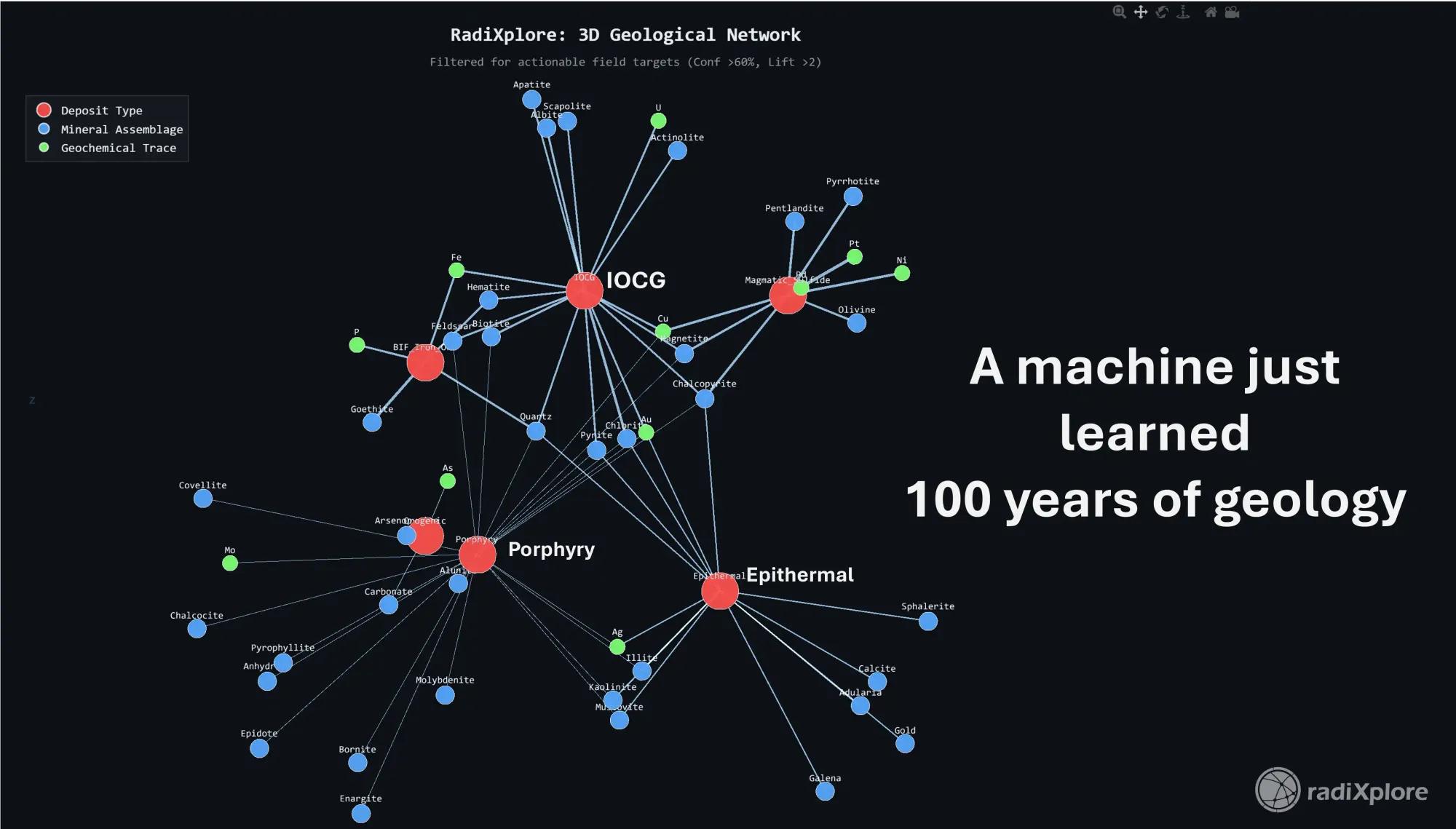
To visualize these 6,600 rules, we set out to build a 3D bipartite network graph connecting the mineral assemblages to their parent deposit types. But our first attempt resulted in what I affectionately call the "Porphyry Hairball."
Out of the 6,600 rules generated by the AI, over 4,200 of them belonged exclusively to Porphyry systems. Why? Because porphyry deposits are the most intricately zoned mineral systems on Earth.
A classic porphyry has a deep potassic core (biotite, magnetite), a phyllic overprint (quartz, muscovite, pyrite), an argillic zone (kaolinite, dickite), and a sprawling propylitic halo (chlorite, epidote). Because our algorithm calculated every possible combination of up to four minerals, the massive zonation of porphyries caused a combinatorial explosion, visually and analytically swamping every other deposit type in the database.
The Actionable Field Filter
To create a tool that is actually useful for mineral explorers, we had to apply a ruthless, geologically meaningful filter to the data:
- High Confidence Only: We filtered out any rule with less than a 60% predictive probability. We only wanted assemblages that reliably point to a specific deposit.
- High Lift (The Tiebreaker): We required a minimum Lift of 2.0 to ensure the signature was genuinely diagnostic and stripped out any lingering ubiquitous minerals.
- The Cap: Finally, we capped the maximum number of rules per deposit type to prevent the highly zoned Porphyry and IOCG systems from dominating the network.
The result? The algorithm distilled 6,600 rules down to the purest, most actionable geological signatures in existence.
When we mapped these filtered rules in 3D, the machine's understanding of global geology became stunningly clear.
Mapping the Machine's Mind: The 3D Mineralogical Network
With the noise filtered out and the data capped to only the most highly predictive, actionable rules, we visualized the results using a 3D bipartite network graph.
Below is the interactive map of the machine's geological rule set.
How to explore the network:
- Rotate & Zoom: Click and drag to rotate the 3D space. Scroll to zoom in and out.
- Hover: Hover over any node to see its connections and geological classification.
- The Colors: 🔴 Red Nodes represent the target Deposit Types. 🔵 Blue Nodes are Mineral Assemblages. 🟢 Green Nodes are Geochemical Trace Elements.
- The Lines: The lines (edges) connecting the minerals to the deposits are weighted by Predictive Lift-the thicker and more opaque the line, the more mathematically anomalous and diagnostic that specific relationship is.
Interactive 3D Bipartite Mineralogical Network. Filtered for high-confidence exploration vectors.
What you are exploring above is not a human interpretation of geology. It is a machine's independent reconstruction of millions of years of hydrothermal fluid dynamics, derived purely by reading textual data.
Here are four major insights the AI discovered entirely on its own.
Insight 1: The Isolated "Islands" (Magmatic & Orogenic)
If you rotate the graph and look at the outer edges of the 3D space, you will immediately notice that certain deposit types sit on isolated islands, completely detached from the rest of the network.
Magmatic Sulfide deposits are anchored exclusively by elements like Pt (Platinum), Pd (Palladium), and Ni (Nickel), alongside minerals like Pentlandite and Olivine. On the other side of the map, Orogenic gold systems form a tight, isolated cluster anchored almost entirely by Arsenopyrite, Carbonate, and the trace element As (Arsenic).
The algorithm independently learned that these systems do not share fluids or genetic pathways with the rest of the map. They are geologically distinct, and the math proves it.
Insight 2: The Porphyry-Epithermal Continuum (The Main Sequence)
If you zoom into the center of the graph, you can explore a dense, interconnected web bridging Porphyry, IOCG, Skarn, and Epithermal deposits. This represents the continuum of high-temperature magmatic-hydrothermal systems.
But look closely at the specific rules the AI generated within this cluster. It formulated the rule:
[Enargite, Feldspar, Biotite] -> Porphyry (100% Confidence)
To a geologist, this is profound. Enargite is a mineral formed by shallow, highly acidic epithermal fluids. Biotite and Feldspar represent the deep, high-temperature potassic core of a magma chamber. Finding them together represents a telescoped porphyry system-a geological event where rapid uplift and erosion cause the shallow epithermal environment to collapse directly on top of the deep magmatic core.
The AI didn't just map minerals; it independently learned the concept of geological telescoping.
Insight 3: The IOCG Na-Ca Footprint
When exploring for Iron Oxide-Copper-Gold (IOCG) systems like Olympic Dam, standard exploration might focus heavily on finding copper at the surface. But the algorithm realized that the ore itself is not the best vector.
In the network, you will see thick, high-confidence edges connecting the IOCG node to Scapolite, Albite, and Magnetite.
The machine figured out that finding the massive, regional Sodic-Calcic (Na-Ca) alteration halos (represented by scapolite and albite) is mathematically a much stronger predictor of a hidden IOCG system than the presence of copper alone.
Insight 4: The Phosphorus Penalty in Iron Ore
The algorithm didn't just map fluid pathways; it also mapped surficial weathering.
Look at the cluster surrounding BIF_Iron_Ore (Banded Iron Formations). The AI generated the rule:
[P, Goethite, Fe] -> BIF_Iron_Ore (85.7% Confidence)
In iron ore mining, Phosphorus (P) is the ultimate penalty element. When banded iron formations undergo supergene weathering, the iron oxidizes into Goethite, and the phosphorus becomes heavily enriched and trapped within that goethite matrix. The algorithm mapped the exact geochemical weathering profile of a Pilbara-style iron ore channel deposit without ever stepping foot in Australia.
From Description to Prediction: The Future of Exploration
Visualizing this 3D network is a fascinating exercise in data science, but beautiful graphs do not discover mines. The true value of this project lies in what comes next.
Association Rule Mining is fundamentally a descriptive algorithm. It tells us what is already there; it maps the established laws of economic geology. But because we now have a mathematically rigid, perfectly cleaned matrix of ~2,000 global deposits, we can flip this architecture from descriptive to predictive.
By feeding this exact same dataset into a supervised Machine Learning model-such as a Random Forest Classifier-we transition from drawing network graphs to building an active exploration targeting engine.
Imagine a greenfield exploration scenario: A field geologist takes a soil sample and maps a nearby outcrop. They don't see any obvious ore, but they record a seemingly random assemblage of alteration minerals and trace elements. They input those observations into the AI.
The model doesn't just look for a single matching rule; it calculates the probabilistic weight of every feature simultaneously. In milliseconds, it outputs a verdict:
"Based on the presence of Albite, Scapolite, and trace Uranium, there is an 82% probability of a concealed IOCG system at depth."
The Path Forward
The easy discoveries have already been made. The next generation of Tier-1 mineral deposits lies hidden beneath hundreds of meters of cover, masking their true signatures behind faint, complex halos of alteration and trace geochemistry.
Human intuition is incredible, but it is prone to bias. We tend to drill where we have drilled before, and we tend to look for the minerals we were trained to look for. By bridging the gap between traditional earth sciences and big data analytics, we can strip away that bias. We can allow the math to guide us toward the hidden, anomalous vectors that textbooks might have missed.
The machine has read the rocks. Now, it's time to see what it can find.
Discover Your Next Target with RadiXplore
At RadiXplore, we aren't just writing about the future of data-driven geology—we are actively building it.
We are taking this exact machine-learning architecture out of the research phase and deploying it as a commercial-grade predictive exploration engine for the mining industry. We have built the pipeline to ingest massive amounts of unstructured text—historical drill logs, surface sampling reports, and legacy geological maps—clean it, and run it through our global targeting matrix to uncover hidden anomalies in your own backyard.
Who should work with us?
If you are a VP of Exploration, Chief Geologist, or Exploration Manager at a junior, mid-tier, or major mining company, the RadiXplore engine is designed specifically for your workflow.
How this benefits your exploration pipeline:
- Maximize Your Legacy Data: Turn decades of dusty, unstructured text reports and forgotten field notes into mathematically backed drill targets.
- See the Unseen: Stop chasing the ubiquitous "quartz-pyrite" noise. Our AI identifies the faint, distal alteration signatures and trace element vectors that point to massive, blind ore bodies hidden beneath cover.
- De-Risk Drill Campaigns: Back your team's geological intuition with unbiased, global-scale probabilistic models. When you have the math to prove a target's viability, securing and deploying exploration budgets becomes significantly easier.
The data is already in your archives. The hidden signatures are already in the ground. You just need the right engine to connect them.
Ready to find what others missed?
Reach out to the RadiXplore team today to see a demo of our predictive targeting engine and learn how we can turn your proprietary unstructured data into your next major discovery.
(Contact us a contactus@radixplore.com or connect with me directly on LinkedIn!)