
Reading Between the Fault Lines: AI Search To Find Missed Deposits in the Curnamona
Millions of pages of historical exploration data in the Curnamona Province remain underutilized. By using AI-driven semantic search to map alteration systems-not commodities-we uncover overlooked IOCG and SEDEX targets hidden beneath cover.

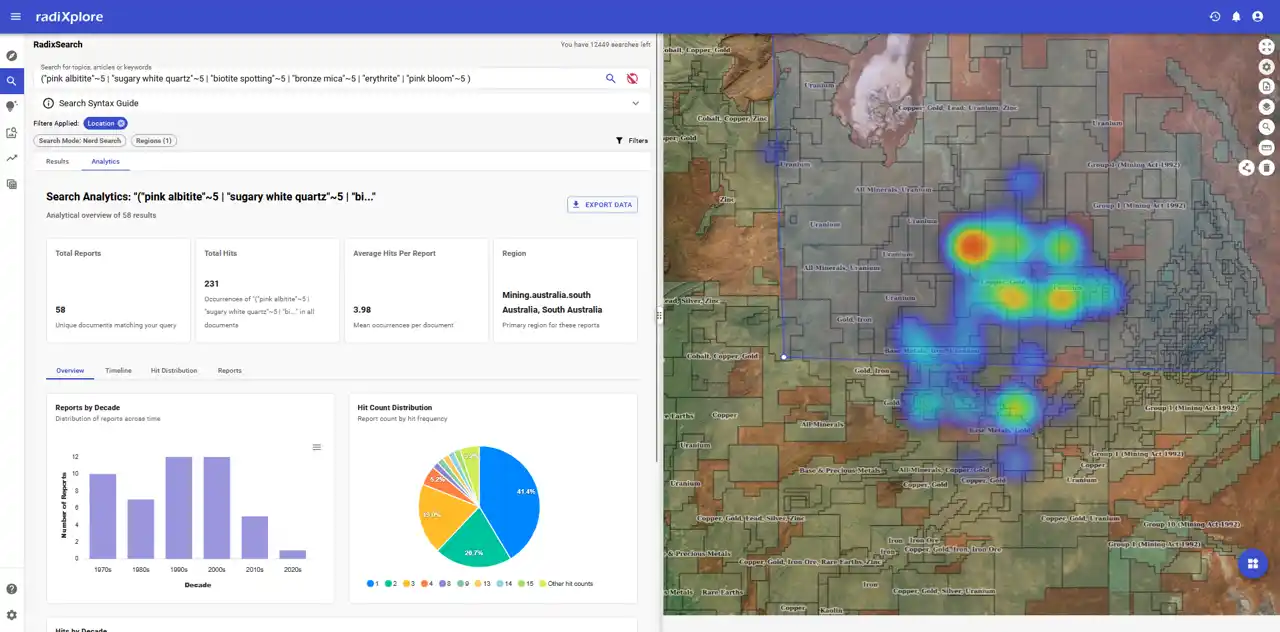
A 317-meter copper intercept. Including 5.8 meters at 1.3% Cu. Drilled in 1995.
Logged. Filed. Forgotten. The explorers walked away. Not because it wasn't there.
But because they didn't understand what they were looking at. This isn't a one-off story. It's the Curnamona Province in a nutshell.
The Curnamona Province is one of the most prospective, yet frustrating, terrains in Australia. It has the right plumbing, the right host rocks, and a proven endowment of world-class copper, gold, and critical minerals.
The problem? Most of it is buried under 60 to 100 meters of transported cover.
For decades, exploration companies have spent millions drilling through this cover, generating mountains of data. That data now sits in the South Australian government's SARIG database-a treasure trove of millions of pages of historical drill logs, annual reports, and field notes (ENV reports).
But here is the dirty secret of modern exploration: most of this data is "Dark Data." If you want to find a missed deposit in the Curnamona today, a standard digital query won't save you. If you CTRL+F for "Copper" or "Au" across the SARIG database, you will be buried in thousands of false positives, promotional fluff, and irrelevant anomalies. Worse, you will completely miss the subtle, overlooked systems where historic explorers walked away because copper prices were low, or because the geology got "too complex."
To find what others missed, we have to stop searching for the element and start searching for the environment.
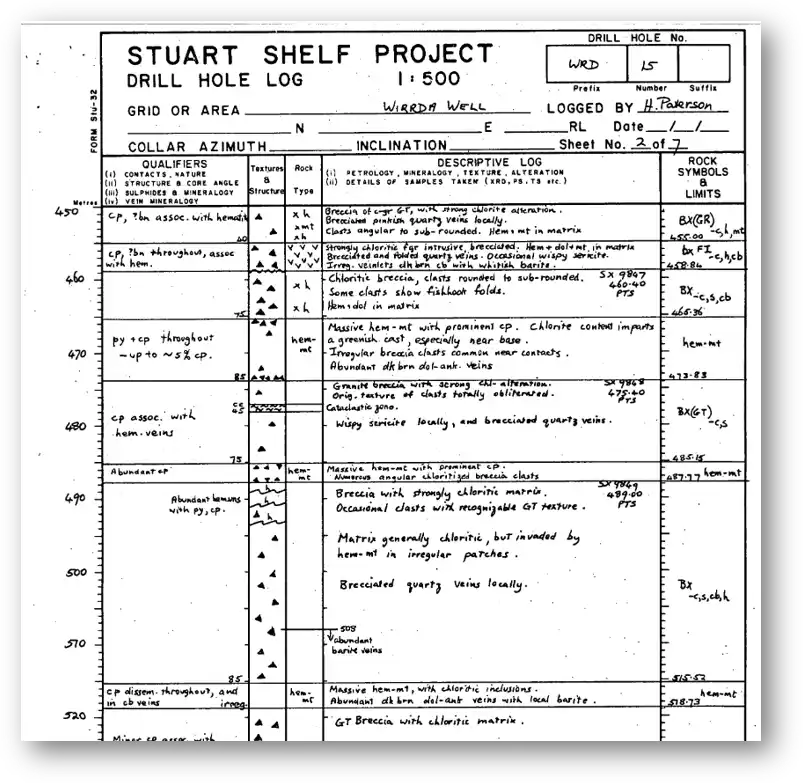
Bypassing the "Modern Geologist Problem"
A few weeks ago, a geologist friend shared his "secret sauce" for identifying VMS mineralization. He wasn't looking for copper or zinc. He was looking for Chloritoid-a specialized shortcut to a VMS footwall.
But he noted a major hurdle: many historical logging databases are riddled with errors because geologists are often inconsistent at identifying specific alteration minerals. If you rely on a 1980s logging code sheet, you are relying on the subjective interpretation of a geologist who was likely under pressure to log 100 meters of core before sundown.
He called this the "Mordern Geologist Problem."
To beat it, we turn to geo-semantic search using RadiXplore. Instead of searching for the strict scientific name of a mineral, we search for the physical, textural description of the alteration system. When geologists don't know exactly what a rock is, they describe what it looks like in the comments section. Those comments are the hidden gems.
In the Curnamona, we aren't looking for VMS; we are hunting for SEDEX and IOCG-style mineralization-specifically, the massive replacement-style systems like Kalkaroo.
The "smoking gun" for these systems isn't necessarily visible chalcopyrite. It's the visual indicators of massive alkali metasomatism (the hydrothermal fluids that bring the copper in).
So, instead of searching the SARIG database for "Copper," we decided to hunt for the halo:
- The Pink Engine: "Pinkish-white sugary texture" or "porcellaneous rock" (Albitite-the brittle sponge for the ore).
- The Distal Halo: "Biotite-speckled metasandstone" or "bronze-colored mica" (Potassic alteration).
- The Critical Sweetener: "Pink bloom on fractures" (Erythrite-the ultimate secondary indicator for high-grade Cobalt-Arsenides).
The Semantic Power Play: Building a Regional Targeting Model
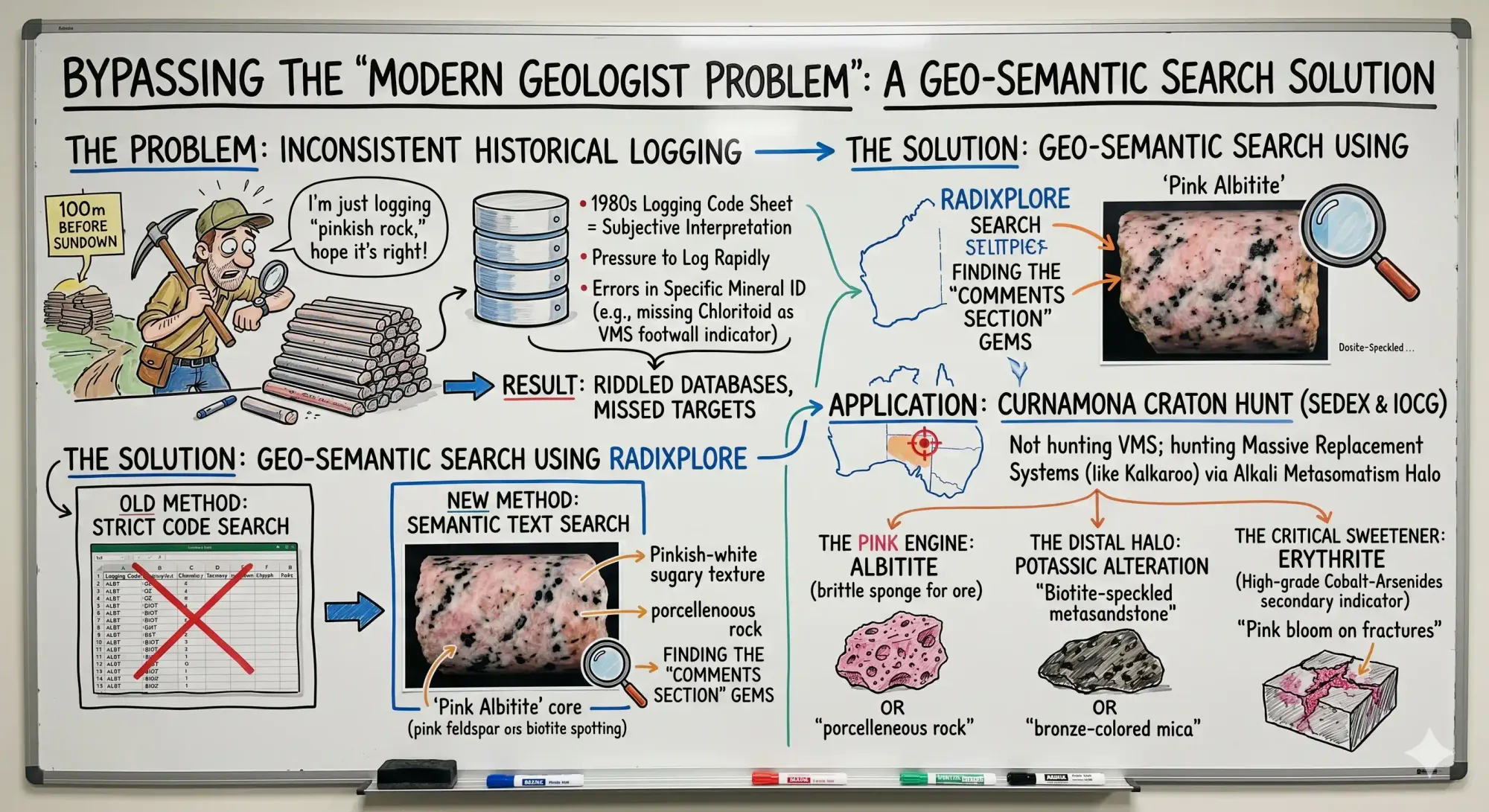
To test our hypothesis in the Curnamona Province, we needed to prove we could map a zoned, district-scale hydrothermal footprint in minutes, rather than the months it usually takes to manually review SARIG ENV reports.
We built a specific NerdSearh query in RadiXplore to search across millions of pages of historical data. We didn't look for "copper assays." We looked for the language used by geologists describing the rocks in real-time.
Instead of searching for 'copper,' we built a search targeting the textural and mineralogical language geologists use to describe alteration halos - proximal indicators like pink-toned albitite and sugary quartz textures, mid-zone markers like biotite spotting and bronze-coloured mica, and the distal cobalt pathfinder erythrite. Using RadiXplore's proximity and semantic matching, these terms were searched together as a weighted cluster rather than isolated keywords, so a report only surfaced if it described the pattern of zonation - not just one mineral in isolation.
This is critical for IOCG targeting. In a massive hydrothermal system, the geology is zoned. The copper heart and the cobalt outer-halo don't always sit in the same 1-meter drill interval. By broadening the net to include proximal indicators (pink albitite) and distal pathfinders (biotite spotting), we aren't just looking for a single high-grade hit; we are mapping the entire regional fluid footprint.
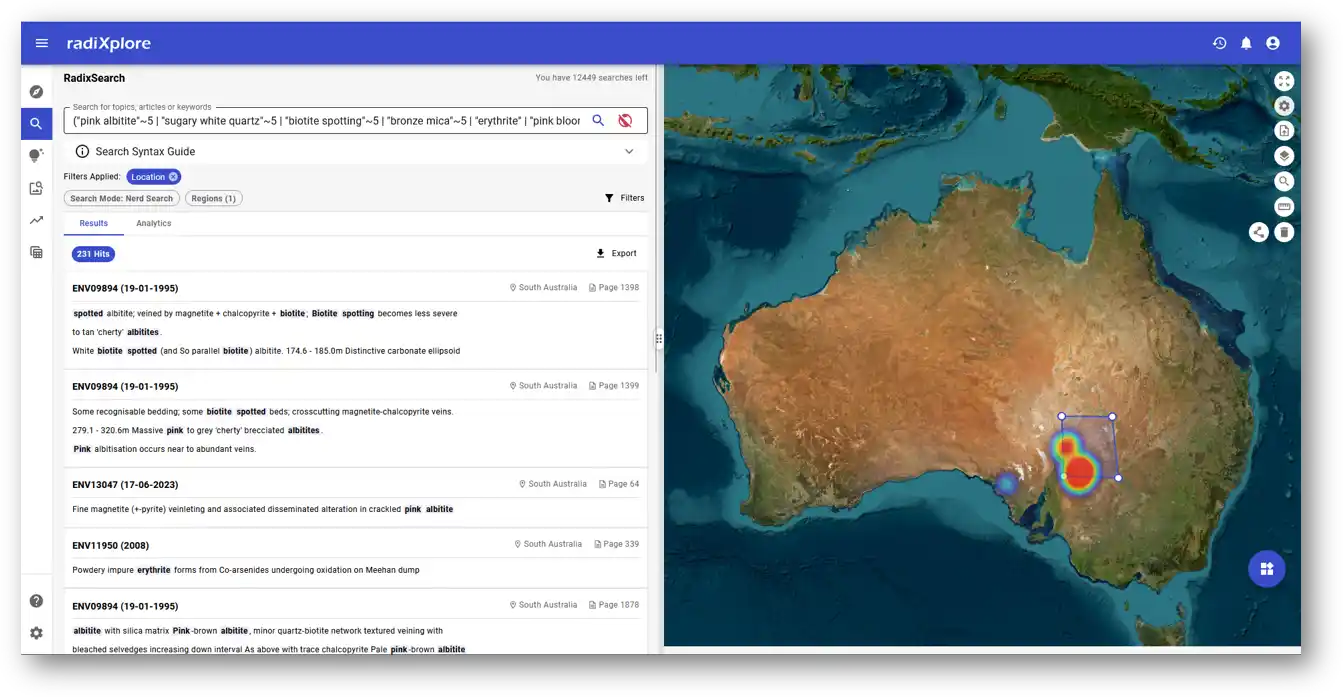
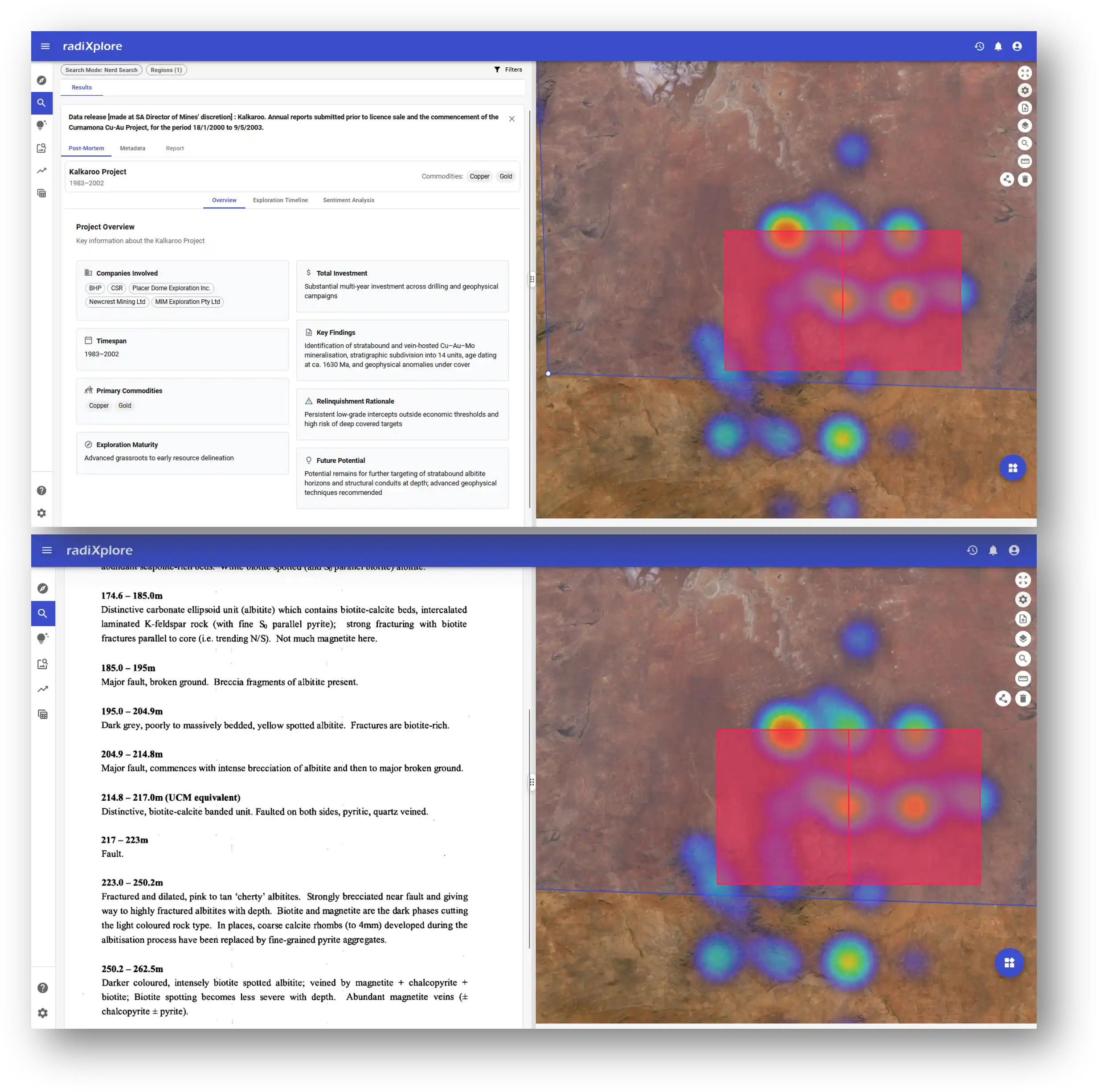
Out of 231 initial document hits, two historical reports stood out immediately, revealing massive near-misses.
Interpreting the "Near Misses": Unearthing Hidden Value
Deep Dive 1: The Missed "Engine Room" (Report ENVaaaa)
This 1995 exploration report details a drilling campaign targeting what we now recognize as a massive replacement-style system. The text reveals a textbook zonation: Biotite Spotted Albitite → Pink Cherty Albitite → Magnetite-Chalcopyrite Veining.
However, the historical explorers walked away. Why? The RadiXplore postmortem reveals two reasons: persistent low grades at the time, and a critical geological assumption.
The drill log for Hole KMD001 contains this buried insight: "In summary, the hole may not have reached the footwall. Structural repetition of units... has seen a repeat of the stratigraphy and intense destruction of many features."
They stopped drilling because the faults made the stratigraphy too complex. But in a modern exploration context, that faulting is the target. The albitite is just the brittle sponge; the mineralizing fluids travel through the faults and breccias. By stopping at the "structural repetition," they effectively walked away from the potential "engine room" of the deposit.
Furthermore, they intersected a massive 317.4m zone at 0.26% Cu in the footwall albitite, which included a higher-grade pulse of 5.8m at 1.3% Cu. What was considered unviable in 1995 is now a highly attractive bulk-tonnage footprint.
Deep Dive 2: The Toxic "Sweetener" (Report ENVbbbb)
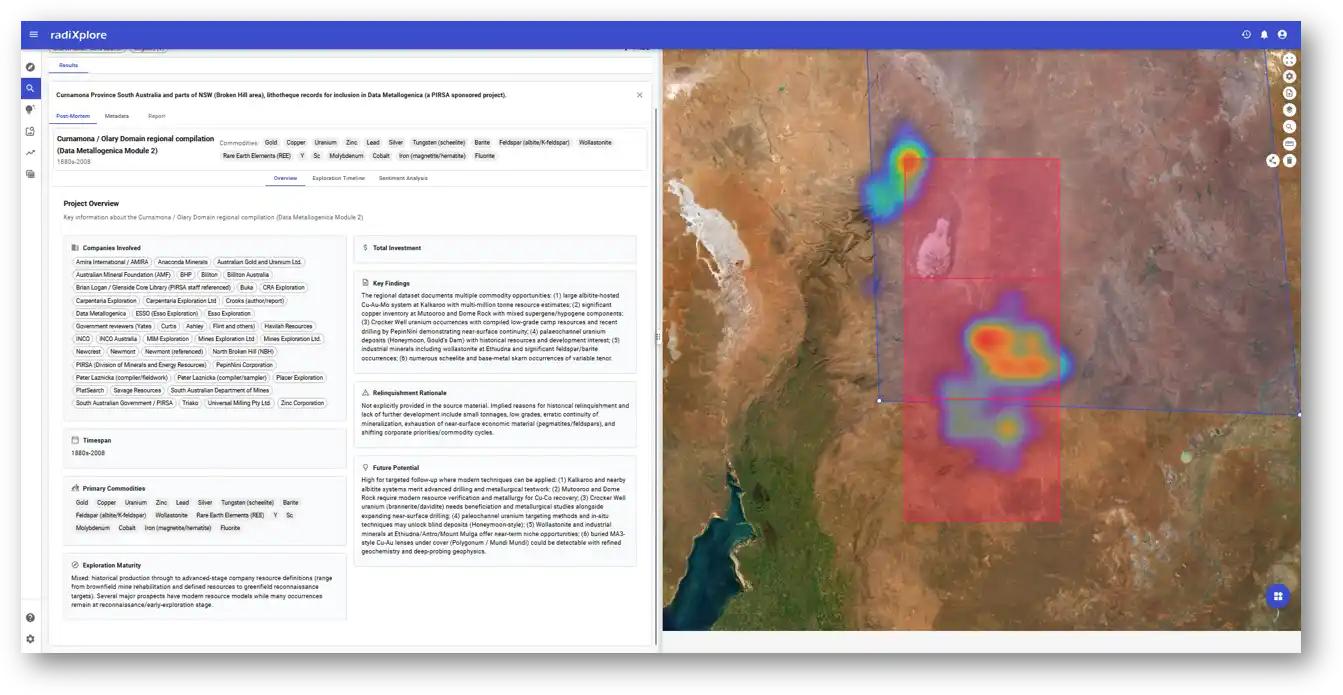
The second major hit came from a regional compilation report detailing historical workings at the Meehan dump. Our semantic search flagged the term "powdery impure erythrite."
Erythrite is "cobalt bloom"-the surface oxidation product of primary cobalt-arsenides (like Cobaltite). In the early 1900s, historical miners actively avoided these zones because arsenic incurred severe penalties at the smelter.
Today, the economics have flipped. Cobalt is a critical mineral. Finding confirmed Erythrite in a historical dump isn't a curiosity; it's a direct vector to high-grade battery metals. When combined with modern processing techniques, these historically "toxic" zones become high-margin satellite targets.
The Geospatial Synthesis: Connecting the District
Here is where the NerdSearch data becomes a predictive exploration model. The Kalkaroo-style albitites (ENVaaaa) and the Meehan cobalt dumps (ENVbbbb) are separated by roughly 200 kilometers.
Traditionally, these would be viewed as isolated anomalies. But the text tells a different story. Both areas are dominated by the exact same magnetic albitite alteration signatures. This proves the Curnamona is a singular, province-wide fluid system-perfect for a "Hub and Spoke" development strategy.
So, how do we find the blind deposits hidden between them under 100 meters of cover? We go back to the historical logs.
The ENVaaaa report noted that while standard soil geochemistry failed to penetrate the cover, partial extraction methods revealed low-order Molybdenum (Mo) and Thallium (Tl) anomalies. Thallium, being highly mobile, acts as a vertical leakage halo above these deep IOCG systems.
By cross-referencing these historical Mo-Tl pathfinder anomalies with the structural "bends" (arcuate domes) seen in the regional geophysics, we can pinpoint the exact pressure-shadow traps where the mineralizing fluids pooled.
From Months of Reading to Minutes of Discovery
What traditionally takes a team of geologists six months of grueling manual review-downloading thousands of SARIG ENV reports, squinting at poorly scanned PDFs, and manually plotting coordinates in a GIS platform-was synthesized into a regional targeting model in an afternoon.
The near-misses hiding in reports like ENVaaaa and ENVbbbb prove a critical point: the Curnamona Province isn't tapped out. The data needed to find the next generation of Tier-1 IOCG and critical mineral deposits is already sitting on a government server. It has just been trapped in "Dark Data."
To unlock it, you need an engine that thinks like an exploration geologist.
Enter RadiXplore: Turning "Dark Data" into Drill Targets
This case study was powered by RadiXplore. We built this platform to solve the exact bottlenecks that keep discovery rates low and exploration costs high.
- Nerdsearch for the Unreadable: Standard text-search fails when faced with the reality of historical data. RadiXplore's Nerdsearch is purpose-built to handle the messiest files in the industry. Whether it's decades-old scanned reports, faded handwritten drill logs, or coffee-stained field notes, Nerdsearch cuts through the noise. It doesn't just look for exact text matches; it understands the semantic, geological relationship between terms (like knowing that "pink bloom" in a 1920s handwritten note is a vector for Cobalt).
- The Postmortem Synthesis: Finding the right historical report is only half the battle; reading a 500-page scanned PDF takes days. RadiXplore's Postmortem feature instantly synthesizes these massive documents into structured, actionable intelligence. It automatically extracts the exploration timeline, the key technical findings, and most importantly, the relinquishment rationale. By summarizing exactly why a historical operator walked away, the Postmortem allows you to instantly identify the geological blind spots and near-misses that your competitors are walking right over.
The era of manually digging through millions of pages of legacy data is over. The next major discovery won't come from who drills the most holes, but from who can read the historical data the smartest.
Stop reading. Start targeting.