
The Carbonatite Was Already There: Using AI Search to Revisit a Near-Miss REE Target in Tamil Nadu
See how RadiXplore used geological-system search to surface an under-tested carbonatite REE and niobium target from historical exploration data in Tamil Nadu, India.

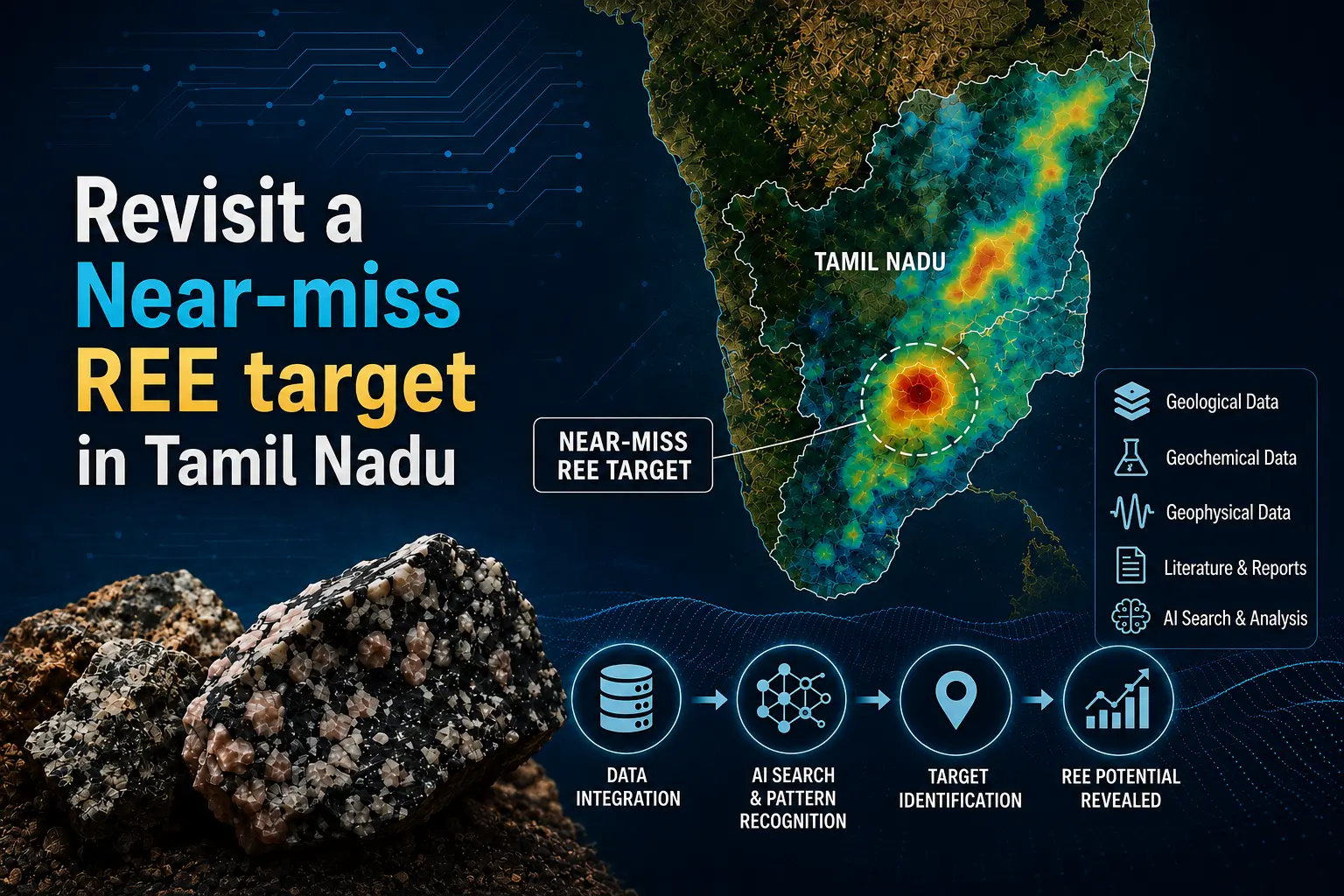
What does an unresolved critical-minerals opportunity look like in historical exploration data?
In the Koratti Syenitic Complex in Tamil Nadu, it looked like this:
- A carbonatite body extending for more than one kilometre
- Total rare earth element values of up to 2,637 ppm
- Five of 59 samples returning more than 2,000 ppm total REE
- Monazite occurring around apatite rims and along fractures in calcite
- Pyrochlore with very high niobium values
- A recommendation for closer sampling and drilling
None of this information was hidden in the sense that nobody had ever seen it.
The Geological Survey of India had already mapped the carbonatite, sampled it and characterised its mineralogy and geochemistry.
The opportunity was different.
The target had been recognised, but it remained unresolved.
For RadiXplore, Koratti became a useful test of a much broader exploration question:
Can historical exploration data be searched for complete geological systems, rather than simply for commodity names or keywords?
The Koratti Carbonatite
During 2017-18, the Geological Survey of India completed a G4 reconnaissance programme across the Koratti Syenitic Complex, covering parts of the Vellore and Dharmapuri districts of Tamil Nadu.
Koratti sits within a broader alkaline-carbonatite province extending through north-western Tamil Nadu.
The complex itself contains a differentiated intrusive system including pyroxenite, multiple syenitic phases and carbonatite.
Its structural setting is also significant.
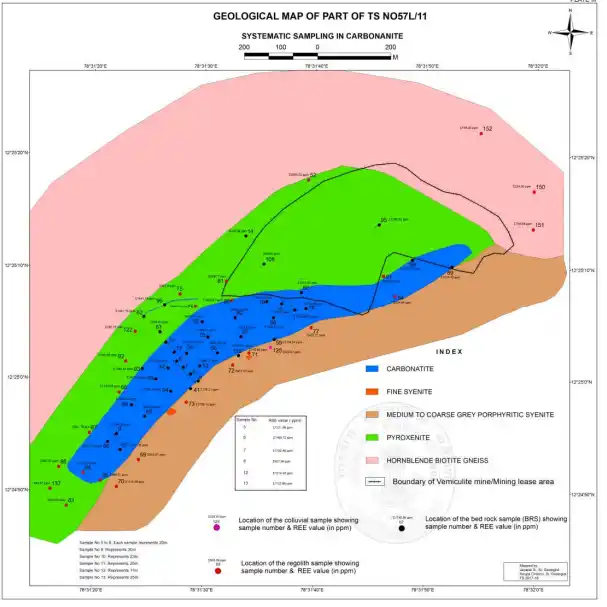
The eastern margin of the complex is truncated by the north-south Pambar shear, while the main carbonatite occurs near the north-western margin of the syenitic complex, close to the contact between pyroxenite and syenite.
The mapped carbonatite is crescent-shaped, extends for more than one kilometre and reaches approximately 200 metres in width.
A smaller parallel carbonatite vein was also mapped north of the main body.
This is not simply a report containing the word carbonatite.
It describes a coherent alkaline-carbonatite geological system.
The Geological Signal Was Strong
GSI systematically sampled the carbonatite on an approximately 100 m × 50 m grid, collecting 59 samples from the body, including 18 regolith samples.
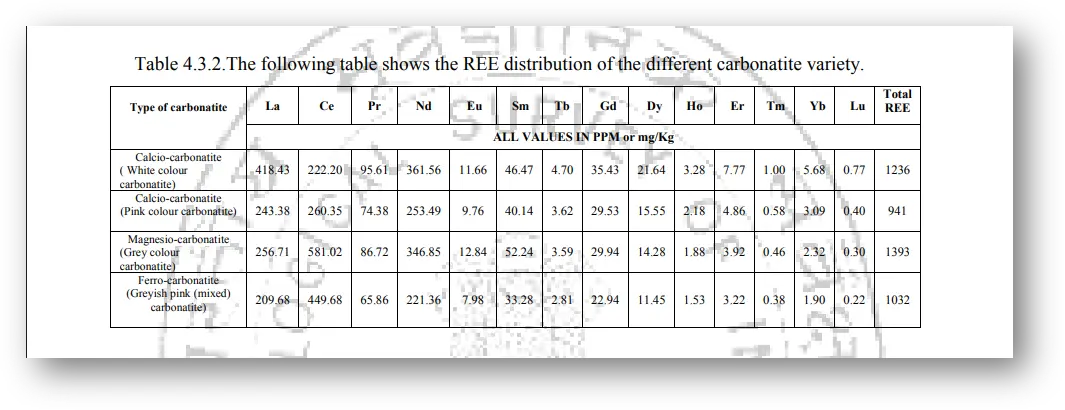
Total REE values ranged from approximately 600 to 2,637 ppm, with five samples returning more than 2,000 ppm total REE.
The assemblage was strongly dominated by light rare earth elements, including lanthanum, cerium, praseodymium and neodymium.
But the assay values are only one part of the story.
The report also describes mineral relationships that provide geological context for the REE enrichment.
Monazite was observed around the margins of apatite grains and along fractures within calcite. The report interpreted this relationship as indicating that monazite enrichment occurred during a later stage of the carbonatite system.
Pyrochlore was also identified within the carbonate minerals, with electron microprobe analysis recording very high niobium oxide values.
These observations matter because they connect the geochemistry to the mineral system.
Instead of simply knowing that elevated REE values occur at Koratti, a geologist can see where the rare earth elements occur mineralogically and how that mineralisation relates to the evolution of the intrusive system.
The Signal Was Also Hidden in the Language
One of the challenges of searching historical exploration reports is that important geological information is not always expressed using neat database terminology.
Geologists describe what they see.
In the Koratti report, the carbonatite is described using field observations including:
- Elephant-skin weathering
- Palm-leaf textures
- Thin partings within the carbonatite
- Concentrations of magnetite and apatite visible on weathered surfaces
- Patches of pyroxenite enclosed within the carbonatite
- Disseminated sulphides
Elsewhere, the mineralogical relationships become even more specific.
Monazite is described around apatite grain boundaries, along fractures in calcite and associated with calcite and dolomite.
These descriptions contain geological meaning that is difficult to capture through a conventional commodity search.
Searching for REE may find pages containing assay values, searching for carbonatite may find geological descriptions, searching for monazite may find mineralogical observations. But the exploration significance comes from seeing these signals together.
Why Koratti Is a Near Miss
Calling Koratti a near miss requires an important distinction. The carbonatite itself was not overlooked. GSI recognised it, mapped it, sampled it and characterised its mineralogy and geochemistry.
The near miss is that the investigation remained at the G4 reconnaissance stage.
G4 work is intended to identify prospective zones and establish whether further investigation is justified. It is not designed to resolve mineralised geometry, continuity or resource potential.
At Koratti, the 100 m × 50 m surface sampling grid was appropriate for reconnaissance.
But it could not determine:
- Whether higher-grade zones continue between samples
- Whether mineralisation extends vertically beneath the surface
- Whether enrichment is structurally controlled
- Whether the anomalous values represent isolated occurrences or continuous mineralised domains
The existing work therefore established that the system was fertile without resolving its architecture.
Most importantly, the original investigation recommended closer-spaced sampling and drilling.
That makes Koratti interesting not because RadiXplore identified a previously unknown carbonatite.
It is interesting because the historical evidence contains both a positive geological signal and an unresolved exploration outcome.
The Search Problem
This is where the case becomes relevant to modern exploration workflows.
Imagine searching a large collection of historical Indian exploration reports for:
REE
The result may contain regional reviews, assay tables, policy documents, exploration summaries and passing references to rare earth elements.
Search for:
carbonatite
and the result becomes geologically narrower, but still contains regional geology, literature reviews and known occurrences with very different exploration histories.
What we really wanted to find was more specific:
Carbonatite systems containing diagnostic REE or Nb mineralogy, positive geochemical evidence and an exploration programme that stopped before the geological question was resolved.
That is not a keyword.
It is a geological concept made up of several connected pieces of evidence.
Searching for the Geological System
RadiXplore approaches this differently.
Instead of starting with a single commodity term, we constructed the search around the geological system we wanted to identify.
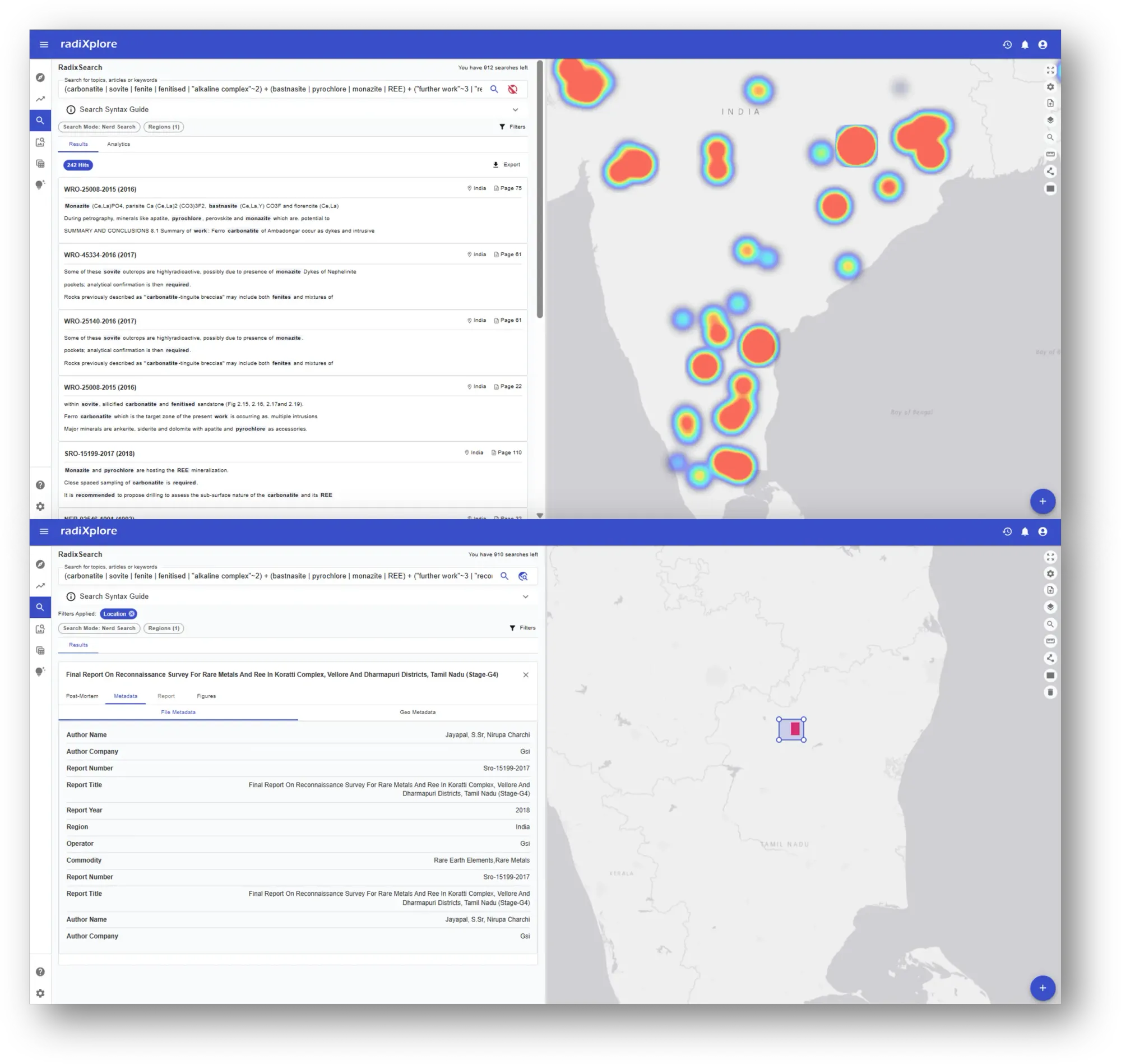
The search considered several classes of evidence together.
Rock types and geological context
Carbonatite, sovite, beforsite and associated pyroxenite.
Diagnostic mineralogy
Apatite, monazite, pyrochlore and magnetite.
Field textures
Descriptions such as elephant-skin weathering, palm-leaf textures and other characteristic carbonatite observations.
Mineral relationships
Monazite associated with apatite rims, grain margins and fractures; pyrochlore occurring within carbonate minerals.
Geochemistry
Total REE, individual light rare earth elements, niobium and tantalum.
Exploration outcome
Language relating to further exploration, closer sampling, drilling, recommendations and unresolved potential.
No individual term is particularly unusual.
The significance comes from their co-occurrence.
A report containing only a regional reference to carbonatite should not rank like a report that contains carbonatite geology, REE-bearing minerals, anomalous assays and an explicit recommendation for further drilling.
This is the difference between searching for a word and searching for a mineral system.
What RadiXplore Surfaced
When the geological-system query was run across the historical data, Koratti appeared among the strongest results.
More importantly, RadiXplore did not simply return the title of a report.
The relevant evidence appeared across several different parts of the document:
- The geological section describing the carbonatite geometry and intrusive setting
- Sampling information showing the reconnaissance grid
- Geochemical results showing the REE distribution
- Mineralogical descriptions linking monazite to apatite and calcite
- Microprobe results characterising pyrochlore
- The recommendation for closer sampling and drilling
Viewed independently, each piece answers a different question.
Viewed together, they form an exploration story:
There is a mapped carbonatite system.
It contains elevated REE values.
The REE enrichment has identifiable mineralogical carriers.
The reconnaissance sampling did not resolve continuity or depth.
Further work was recommended.
The geological question remained open.
That is the result we were looking for.
RadiXplore Did Not Discover Koratti
This distinction is important.
RadiXplore did not discover the Koratti carbonatite.
GSI had already done the fieldwork required to identify, map, sample and understand the system at reconnaissance scale.
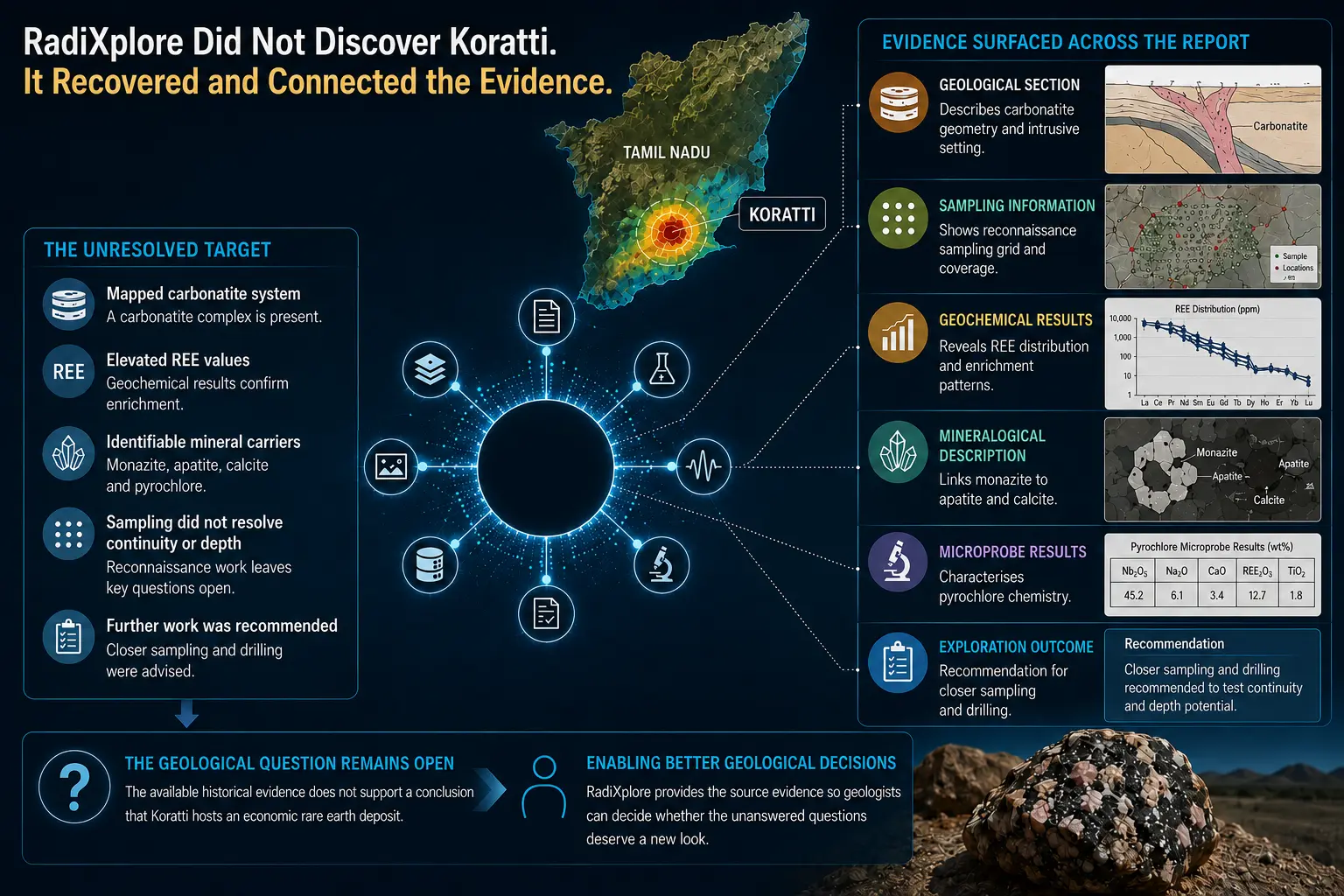
Nor does this case demonstrate that Koratti contains an economic rare earth deposit. The available historical evidence does not support that conclusion.
What RadiXplore did was recover and connect the evidence that makes the unresolved target worth examining again.
That is a very different capability from prediction.
The system is not saying:
There is a deposit here.
It is saying:
These geological observations, mineralogical relationships, assays and exploration outcomes occur together. The original programme stopped before several important questions were resolved. Here is the source evidence so a geologist can decide whether those questions deserve another look.
Why This Matters for Historical Exploration Data
Koratti is one example of a much larger exploration problem.
Historical geological reports contain enormous amounts of information that cannot be represented adequately by a report title, commodity tag or database record.
The useful evidence may be distributed between:
- Geological observations
- Field descriptions
- Assay tables
- Petrography
- Mineral chemistry
- Maps
- Drill results
- Conclusions
- Recommendations
The exploration opportunity may only become apparent when those different pieces are considered together.
That is particularly important when several generations of exploration have worked across the same area.
One programme may map an anomaly.
Another may sample it.
A later explorer may test one interpretation but not another.
A recommendation may appear in the final pages of a report and never become part of the structured exploration record.
The challenge is reconstructing what it collectively means.
From Retrieval to Evidence Synthesis
This is the capability Koratti demonstrates.
A conventional search asks:
Where is carbonatite mentioned?
A geological-system search asks:
Where do the geological, mineralogical, geochemical and exploration signals of an unresolved carbonatite-hosted REE system occur together?
That second question is much closer to how an exploration geologist actually reasons.
RadiXplore is designed to help make that type of investigation possible across large historical datasets.
It surfaces the evidence, connects related observations and keeps the findings traceable back to the original geological sources.
The interpretation still belongs to the geologist.
The Carbonatite Was Already There
The most interesting thing about Koratti is that there was no need to invent a new geological story.
The story was already contained in the historical work. A kilometre-scale carbonatite had been mapped.
REE anomalism had been recorded . The mineral carriers had been identified.
The exploration programme had established fertility without resolving continuity or depth and further work had been recommended.
The opportunity was not hidden because the data did not exist.
It was hidden in the connections between pieces of evidence that had to be read together.
That is the broader lesson from Koratti.
As more historical exploration information becomes digitally accessible, finding documents becomes less of the bottleneck.
The next challenge is understanding which observations matter together, which geological questions remain unresolved and which parts of the historical record deserve another look.
Sometimes the next exploration opportunity does not begin with collecting new data.
Sometimes, the carbonatite was already there.
You have historical data too. What might be sitting inside it?
Explore it using RadiXplore.
Contact Us